Write the final wording once
Copy the exact name into a plain text note, including spaces, punctuation and preferred capitalisation. Check it against a reliable source rather than typing it from memory during checkout. If the sign includes a date or second line, label each field clearly. Avoid supplying several alternative spellings and expecting the maker to decide which is correct.
Consider the available width. A long name in a flowing script may need a different layout from the short sample shown in the listing. Ask whether the font size changes with name length and whether any parts become unusually narrow. A preview should show your actual text, not just a generic placeholder in the same style.
Review it at actual scale
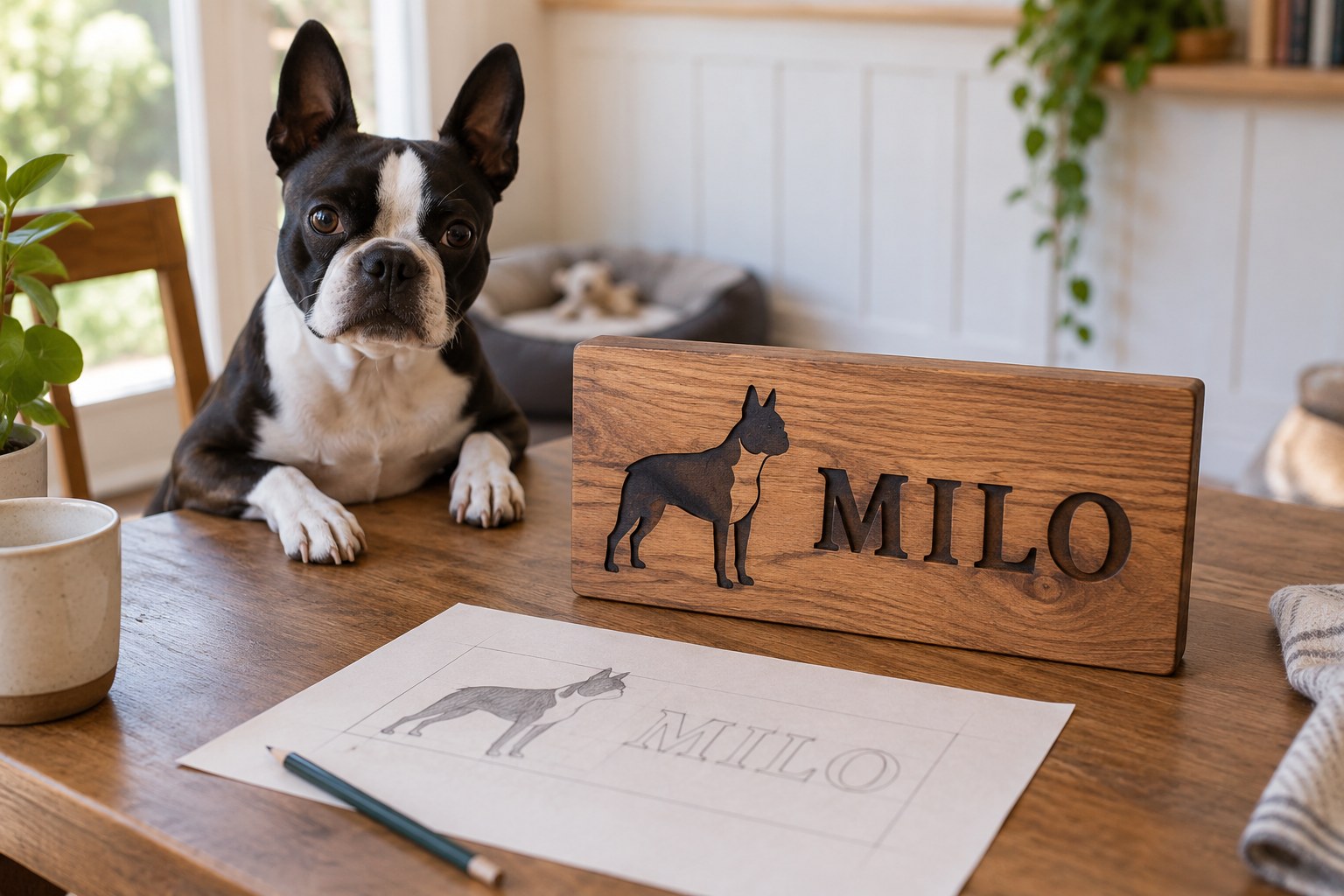
Print the proof at its intended size if the file allows, or draw the outer dimensions on paper and compare the letter height. Stand where the sign will usually be read. Check the spacing around repeated letters, joins in script and the distinction between similar characters. Looking closely at a large phone preview can make almost any lettering seem readable.
Review the outline as well as spelling. Cut-out lettering may contain delicate projections or unsupported parts, while a printed plaque can have borders and holes that affect the text area. Ask the maker about unclear construction details rather than assuming a digital image shows every join and fixing point.
Agree how it reaches the wall
Confirm material, thickness, overall dimensions and finish. Ask whether hanging hardware is supplied and whether the sign is intended for indoor or outdoor use. Measure the destination and consider doors, furniture and access for cleaning. Use the maker's mounting instructions with fittings suitable for the surface; do not choose a fastening solely because it will be hidden behind the name.
Check whether the mounting position affects the design. A hole near a thin letter or a visible bracket beside the first character may change how the name reads. Ask for those features to be shown in the proof where possible. If the piece is freestanding, request its base dimensions and a side view instead. Decide where it will sit before approving a shape that depends on an invisible support in the promotional photograph.
Make approval a deliberate step
Read when the order becomes fixed, how corrections are handled and whether changes affect production time. Send one collected response identifying any edits. After receiving a revised proof, recheck the whole sign, including unchanged lines, before approving it. Keep a copy of that approval with the order record.
Inspect the finished piece before installation. Compare it with the approved proof and verify that all supplied parts are present. Retain packaging if a problem needs to be reported. For a gift, include the mounting and care information so the recipient does not have to guess how the sign should be used.